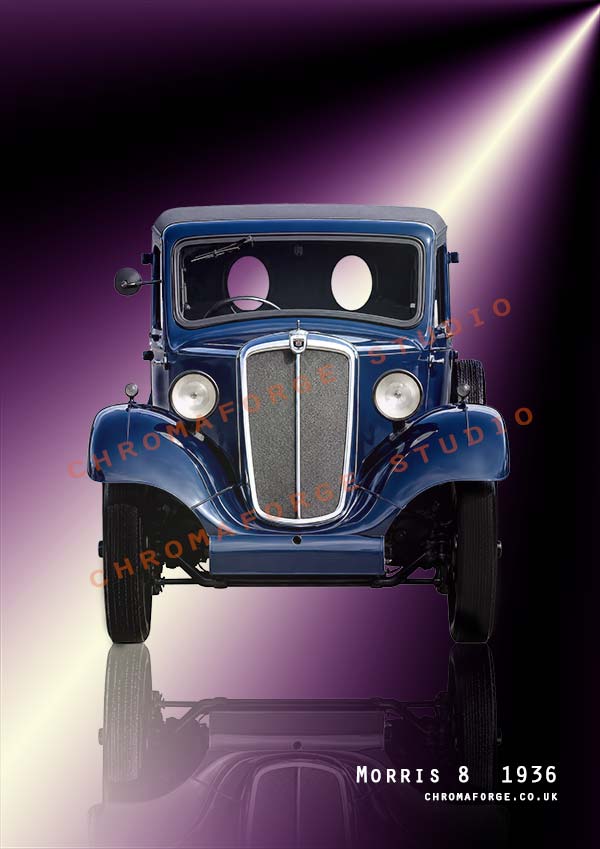
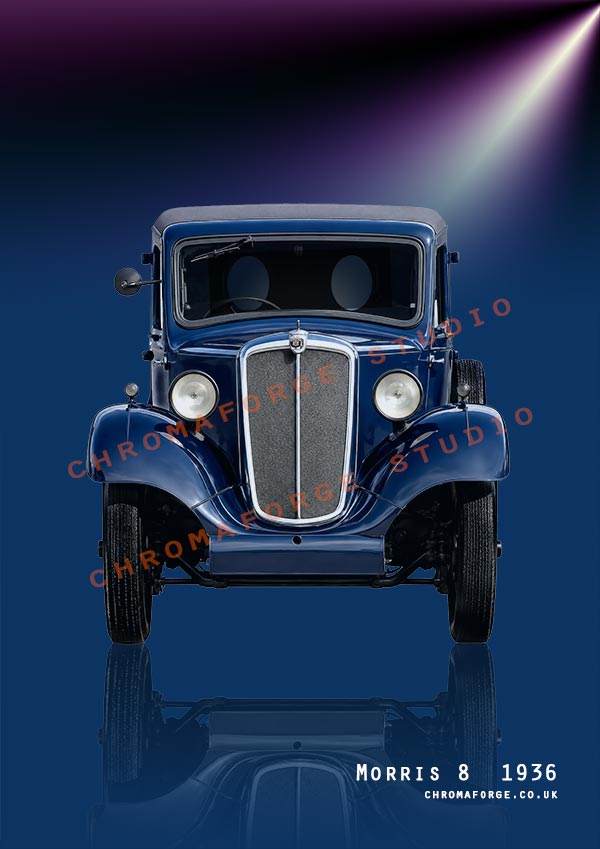
The Morris Eight was created at a time when Morris Motors badly needed a winner. During the early 1930s the company had lost ground in Britain's increasingly competitive small-car market, particularly to Ford's remarkably successful Model Y. Morris responded with an entirely new small family car, developed under managing director Leonard Lord and launched at the 1934 London Motor Show. By 1936 it had become known as the Morris Eight Series I — and the response from British motorists was emphatic.
Built at Morris's Cowley works in Oxford, the Eight was deliberately aimed at ordinary motorists who wanted an affordable car without feeling they had bought something austere. Its styling owed a clear debt to the Ford Model Y, but Morris combined that familiar shape with a more generously equipped and comfortable package. With its upright radiator grille, sweeping front wings, running boards and wire wheels, the 1936 Morris Eight has all the visual character we now associate with British motoring between the wars.
It was a genuinely versatile little car. Morris offered two- and four-door saloons alongside open tourers and commercial versions, allowing the Eight to serve as family transport, a commuter, a tradesman's vehicle or simply an affordable first car. At a time when car ownership was still beyond the reach of much of the population, cars such as the Morris Eight were helping to make private motoring attainable for a much wider section of British society.
Most importantly for Morris, it worked. The Eight became a huge sales success and helped return the company to the forefront of British car manufacturing. More than 200,000 were produced during the original four-year design's production run, and Morris went on to become the first British manufacturer to build a million cars by 1939. The 1936 Morris Eight Series I therefore represents more than an appealing pre-war family car — it was one of the cars that helped put Morris back on top.